


 Magyar
 Deutsch
 Italiano
 Español
 中文
中文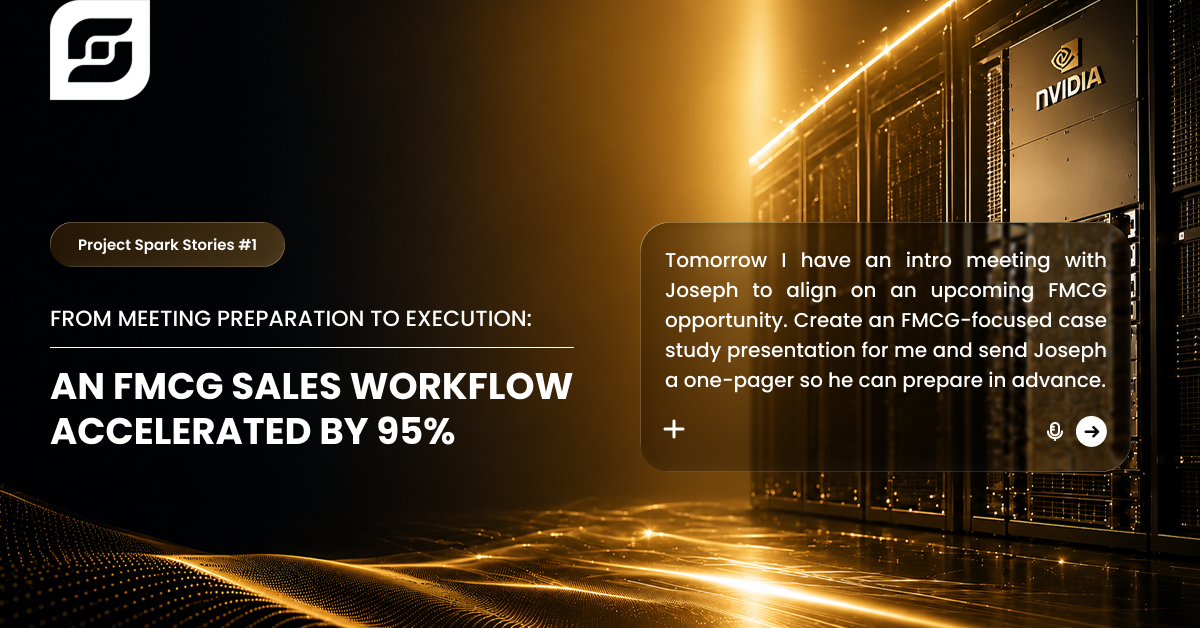
Project Spark Stories #1
One of the key takeaways from Executive Espresso Vol. 3 was that AI is no longer the challenge. Operational integration is. Today, most companies already use AI to generate content, summarize meetings, translate documents, or create presentations. Yet despite these advances, many organizations continue to struggle with the same challenge they faced before AI entered the workplace: efficiently executing day-to-day business processes.
The reason is simple. While AI has become exceptionally good at producing outputs, the operational work surrounding those outputs often remains manual. Employees still spend a significant portion of their day collecting information, coordinating tasks, moving data between systems, and ensuring that work actually gets done.
At first glance, this seems like the perfect task for AI.
- You can ask one tool to create the presentation.
- Another can help draft the email.
- A third might summarize previous customer success stories or gather industry insights.
However, once the content has been generated, the real work begins. Someone still needs to collect the right information, review the materials, ensure they are relevant to the opportunity, send the documents, manage versions, and coordinate the entire process. The AI may have accelerated individual tasks, but the employee remains responsible for connecting all the pieces together.
This was exactly the challenge we wanted to solve when developing Project Spark.
 Powered by NVIDIA's latest AI-optimized supercomputing infrastructure, Project Spark operates within a fully controlled on-premise environment, helping employees delegate operational workflows through simple natural language requests.
Rather than building another AI assistant that simply produces content, our goal was to create an environment where AI could participate in operational execution. We wanted employees to focus on business objectives while the system handled much of the underlying workflow. Instead of manually coordinating multiple tools and processes, an employee can simply provide a business instruction:
From there, the system can retrieve relevant internal knowledge, identify suitable FMCG references, prepare the presentation, generate supporting materials, create the communication, and complete the necessary actions across connected systems. The important distinction is that the employee is no longer managing a collection of AI tools. Instead, they are delegating an operational objective. This shift may sound subtle, but its impact is significant.
When we evaluated this workflow internally, we found that operational execution time could be reduced by up to 95%. The improvement did not come from generating slides faster or writing emails more quickly. It came from eliminating the manual coordination work that traditionally sits between every task.
In our experience, this is where the next phase of enterprise AI will emerge. The conversation is gradually moving away from prompt engineering and content generation. Organizations are beginning to ask a different question: how can AI help execute real business processes?
The companies that gain the greatest value from AI over the coming years will not necessarily be those using the most AI tools. They will be the ones that successfully integrate AI into their operational workflows, allowing employees to spend less time coordinating processes and more time making decisions, serving customers, and creating value. That vision is what led us to build Project Spark: a platform designed to help employees delegate operational tasks, accelerate workflows, and focus more of their time on decisions that create business value.
Interested in the Full Use Case?
Download our free Project Spark use case to explore how AI can support real operational workflows across sales, HR, IT, marketing, and other business functions.