


 Magyar
 Deutsch
 Italiano
 Español
 中文
中文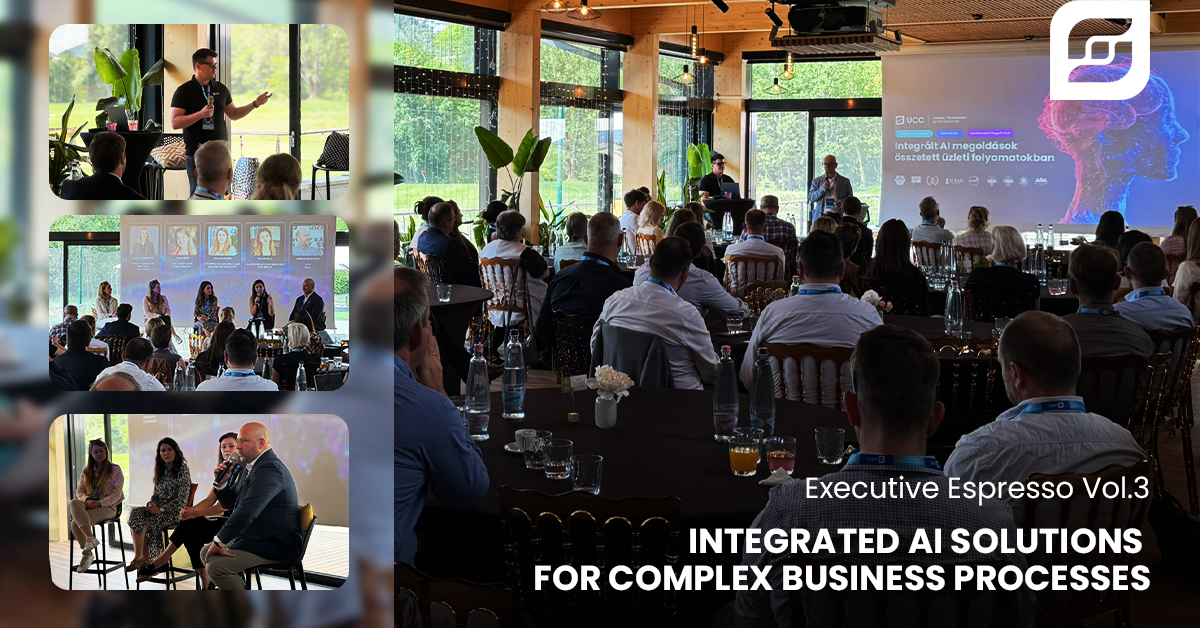
On June 2, business leaders, technology experts, and digital transformation professionals gathered at Continental Citygolf Club in Budapest for the third edition of Executive Espresso, hosted by UCC. This time, the focus was on a topic that is rapidly becoming a boardroom priority across industries: how to successfully integrate AI into complex business processes.
While artificial intelligence adoption continues to accelerate globally, the event highlighted a crucial reality: the challenge is no longer whether organizations should use AI, but how they can transform isolated AI initiatives into scalable, secure, and business-driven solutions.
From AI Experiments to Business Transformation
Opening the event, Richárd Kozma, Managing Director of United Call Centers, emphasized that organizations are entering a new phase of AI adoption.
"The real competitive advantage will not come from using more AI tools. It will come from connecting people, processes, and AI capabilities into a unified operational model."
The Hidden Risk of Shadow AI
One of the most thought-provoking discussions focused on the growing phenomenon of "Shadow AI" – employees using public AI tools outside corporate governance frameworks.
Balázs Kopcsó, Head of Innovation and Technology at UCC, highlighted that while AI tools significantly improve productivity, they can also introduce serious security and compliance risks when used without oversight.
"Many organizations are already using AI extensively without realizing how much sensitive information is being shared outside their controlled environments. Governance is becoming just as important as innovation."
During his presentation, Balazs demonstrated how modern AI platforms can move beyond simple chat interfaces and become intelligent orchestration layers capable of managing workflows, knowledge bases, ticketing systems, CRM functions, and customer journeys within a single ecosystem.
Building Enterprise AI Beyond Pilots
IBM's presentations focused on one of the biggest challenges organizations face today: turning AI adoption into measurable business value. While most companies already use AI in some form, many struggle with fragmented systems, poor data quality, and disconnected workflows that prevent successful scaling.
A key topic was the rise of Agentic AI, where intelligent agents move beyond simple question-answering and actively collaborate across systems, workflows, and business functions. From customer service and ticketing to sales support and document processing, AI agents are increasingly becoming active participants in enterprise operations.
"The future of AI is not about deploying more tools. It is about connecting data, processes, and AI capabilities into a unified business ecosystem."
The session also showcased how AI can enhance omnichannel order management, helping organizations optimize inventory visibility, order fulfillment, and customer interactions in real time. The message was clear: successful AI transformation requires strong foundations in data, governance, and integration, combined with a clear focus on business outcomes rather than technology alone.
Human and AI Collaboration: The Panel Discussion
The event concluded with a panel discussion moderated by Annamária Ughy (TD SYNNEX), featuring representatives from UCC, OTP Group, Magyar Telekom, and RSM Hungary. The discussion moved beyond technology and focused on the human side of AI adoption.
Participants agreed that successful AI transformation is not about replacing employees but augmenting their capabilities.
"The organizations that succeed with AI will be those that create effective collaboration between human expertise and machine intelligence," said Zsolt Máté Juhász, CEO of UCC.
Topics included:
- Change management
- Employee adoption
- AI governance
- Data privacy
- Customer trust
- Measuring business value
The consensus was that AI should be viewed as a business transformation initiative rather than a standalone technology project.
Looking Ahead
Executive Espresso Vol. 3 reinforced a message that is becoming increasingly evident across industries: the future of AI belongs to organizations that can combine technology, governance, data quality, and human expertise into a cohesive operating model.
As AI evolves from standalone tools into interconnected business agents and workflow orchestrators, enterprises face a unique opportunity to redesign how work gets done. The question is no longer whether AI will become part of everyday business operations. The question is how effectively organizations can build a future where humans and AI work better together.
Human. Technology. Better Together.